Automated Product Research Agent
An n8n-based agentic workflow that automates e-commerce product validation using a multi-platform data-driven framework.
In e-commerce, the most successful products aren’t found by luck; they’re validated by data. Guesswork is expensive, but automated, data-driven analysis provides a clear, repeatable path to success. This project was built to automate that path.
🤔 The Problem: The High Cost of Guesswork
Winning in e-commerce hinges on selecting the right product. However, the manual research process is fundamentally broken. It’s a time-consuming, repetitive, and often subjective task that involves juggling dozens of tabs, manually checking data points, and ultimately relying on a “gut feeling.”
This traditional approach leads to critical errors:
- Wasted Ad Spend: Testing products that have no real market demand.
- Market Saturation: Entering crowded markets too late, leaving no room for profit.
- Subjective Decisions: Choosing products based on personal bias rather than objective data.
- Inconsistent Results: The lack of a systematic process makes success feel random and unrepeatable.
The Automated Product Research Agent was engineered to replace this flawed manual process with a ruthlessly efficient, data-driven validation engine.
🎯 What is the Automated Product Research Agent?
This project is a powerful, agentic workflow built entirely on n8n to automate the complex process of e-commerce product validation. It implements a strict, multi-step framework that systematically analyzes a product’s viability across multiple platforms. By leveraging AI agents and direct API integrations, the workflow transforms a simple product idea into a clear, data-backed “Go/No-Go” decision.
The core purpose is to:
- ✅ Maximize Product Hit Rate by focusing only on data-validated products.
- ✅ Eliminate Wasted Time & Money by automatically discarding weak candidates early.
- ✅ Enforce a Consistent Strategy that turns product research from a gamble into a system.
🏗️ A Look Inside: The Validation Pipeline
The entire system is designed as a sequential, multi-gate pipeline. A product idea enters at the start and must successfully pass through each validation stage to be approved. A failure at any critical gate immediately terminates the workflow for that product, ensuring that only the strongest candidates make it to the final output.
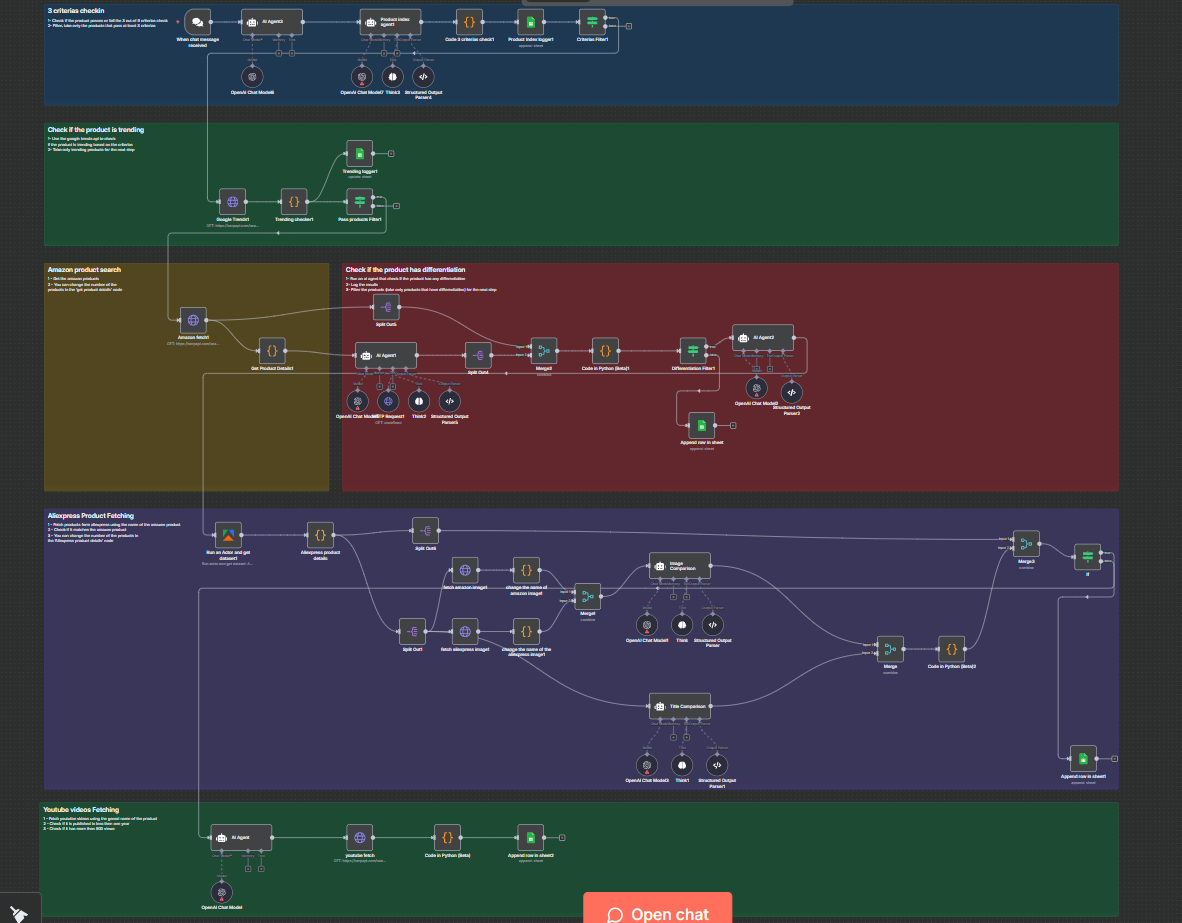 Figure: The n8n workflow, showcasing the sequential validation gates from initial criteria check to final approval.
Here’s the journey of a product through the pipeline:
- Initial Vetting: The workflow begins with a qualitative check using an AI Agent to see if the product concept aligns with fundamental e-commerce success criteria.
- Market Demand Analysis: The product’s trendiness is validated using real-time Google Trends data. No trend, no product.
- Competitive & Differentiation Analysis: The agent scours Amazon to assess existing competition and, crucially, uses another AI agent to determine if the product has meaningful differentiation, not just superficial changes.
- Supplier & Saturation Check: The workflow then moves to AliExpress to find potential suppliers while simultaneously checking for market saturation by analyzing order volumes. It performs an AI-powered image and title comparison to ensure product consistency.
- Audience Verification: Finally, the system queries YouTube to confirm that an active and engaged community exists around the product’s niche, validating a receptive audience.
- Final Approval: If a product successfully navigates all gates, its data is neatly compiled and appended to a Google Sheet, creating a “Product Arsenal” of pre-vetted winners ready for testing.
🤖 The Brains: The Automated Validation Gates
The intelligence of the system lies in its deterministic, AI-powered gates. Each one serves as a critical checkpoint that a product must clear.
Gate 1: The 5-Criteria Check
Before any technical analysis, an AI Agent performs a qualitative check. It assesses the product concept against 9 core “winning criteria” (e.g., solves a problem, improves convenience, saves time). The product must satisfy at least three of these criteria to proceed. This initial step filters out ideas that lack a strong fundamental value proposition.
Gate 2: Google Trends Validation
To confirm real-time market demand, the workflow queries Google Trends for the past 90 days. It enforces a strict 3-point rule: interest must be above 35, have spent significant time above 50, and show a stable or upward trend. This gate ensures marketing efforts aren’t wasted on a dying trend.
Gate 3: Amazon Market & Differentiation Analysis
The agent performs a search on Amazon to analyze the competitive landscape. More importantly, a dedicated AI Agent evaluates if the product has true differentiation. It’s trained to distinguish between meaningful benefits (new features, better utility) and “fake” differentiation (different colors, minor pattern changes), a critical factor for market entry.
Gate 4: AliExpress Supplier & Saturation Check
Using the product details, the workflow identifies potential suppliers on AliExpress. Simultaneously, it acts as a defense against oversaturation by flagging any single listing with over 25,000 orders. This gate includes a sophisticated AI-powered image and title comparison to match the Amazon listing with the supplier’s listing, preventing costly mismatches.
Gate 5: YouTube Niche Validation
A product is only as strong as its audience. This final gate validates the existence of an engaged community by searching YouTube for niche-related content. It requires finding at least five recent videos with over 5,000 views, proving that a ready and interested audience exists.
🧰 Tech Stack
- Core Workflow Engine: n8n.io
- AI Agents: OpenAI GPT models integrated via n8n nodes for qualitative analysis, comparison, and structured data output.
- Data Sources:
- Google Trends: For market demand validation.
- Amazon: For competitive and differentiation analysis.
- AliExpress: For supplier research and saturation checks.
- YouTube: For audience and niche validation.
- Data Storage: Google Sheets for storing the final list of validated products.
- Custom Logic: Python Code nodes within n8n for bespoke data processing and implementing specific validation rules.
📝 Recap: Key Takeaways
The Automated Product Research Agent is more than a workflow; it’s a systematic engine for making smarter decisions in e-commerce.
- Automates a Manual Process: It replaces dozens of hours of repetitive manual research with a fully automated, end-to-end pipeline.
- Data-Driven & Objective: Removes guesswork and personal bias, relying instead on a strict framework and live data from key platforms.
- Reduces Financial Risk: By “failing fast” and automatically filtering out weak products, it minimizes wasted ad spend and inventory investment.
- Leverages Agentic AI: Uniquely integrates AI agents to perform complex qualitative tasks like differentiation and criteria analysis within a deterministic, repeatable workflow.
- Creates a Winning Pipeline: The output is not just a single idea but a curated “arsenal” of validated products, enabling consistent and scalable testing.
🙌 Authors
Built with care by ZAGHLAOUI Karim & KAOUANE Ameur Automation & AI Systems experts